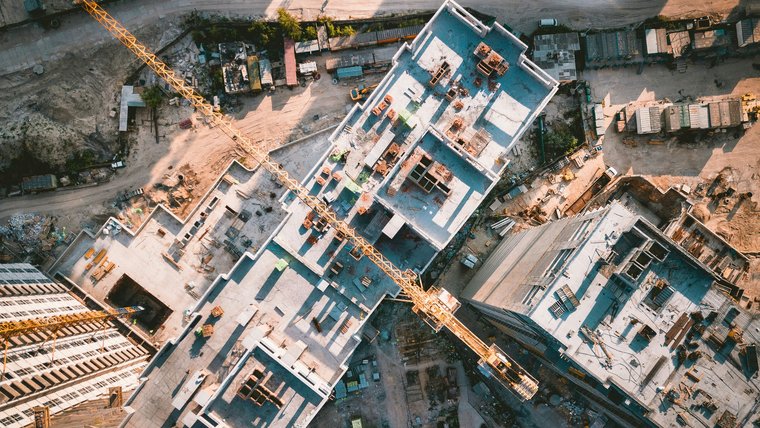
According to INE, in the fourth quarter of 2025, approximately 5,800 buildings were licensed in Portugal, representing a year-over-year decrease of 14.2%, following a 2.6% decline in the previous quarter. Of the total number of licensed buildings, 77% were for new construction, and of these, 82.5% were intended for single-family housing. Additionally, 273 buildings were licensed for demolition, accounting for 4.7% of the total.
The decline in the number of licensed buildings was widespread across all regions of the country, with the largest drops recorded in the Setúbal Peninsula (-34.2%), the Alentejo (-25.5%), and the Algarve (-23.3%).
New building permits fell by 11.4% year-over-year and by 7.7% compared to the previous quarter. Renovation projects also saw a significant decline, down 22% from the same period in 2024 and 12% from the previous quarter. Regionally, the decline in new construction was observed throughout the country, with the Setúbal Peninsula (-32.7%) and the Alentejo (-20.2%) standing out once again.
Despite the decline in the number of licensed buildings, the number of housing units in new construction for single-family homes increased. In the fourth quarter, 10,900 housing units were licensed.
Greater Lisbon recorded the highest growth, with an increase of 89%, followed by the North (+19%), the West and Tagus Valley (+16.8%), the Center (+5.4%), and the Algarve (+5.2%). The remaining regions saw declines, notably the Setúbal Peninsula (-37.6%), the Autonomous Region of Madeira (-31.3%), the Alentejo (-23.8%), and the Autonomous Region of the Azores (-6.8%). Growth in Greater Lisbon was driven mainly by the municipalities of Lisbon, Sintra, and Oeiras.
The total licensed area also recorded a 2.9% year-over-year increase, following a sharp 24.9% decline in the previous quarter. The Algarve posted the highest growth (+55.9%), followed by Greater Lisbon (+29.2%), Oeste and Vale do Tejo (+8.2%), the Azores (+6.7%), and the Center (+0.3%). In the Algarve, the increase was driven by the licensing of new housing units and tourist developments, particularly in the municipalities of Lagos and Silves.
Regionally, the North remained the leading region in terms of building permits, accounting for 38.4% of all permitted buildings, 39.4% of new construction, and 34% of buildings slated for renovation. The Center ranks second, while the West and Tagus Valley region ranks third in terms of total permitted buildings and new construction. In the case of renovation projects, the third position belongs to Greater Lisbon.
Regarding licensed units in new family housing construction, the North accounted for 45.4% of the national total, followed by Greater Lisbon (17.8%) and the Center (15.2%).
The municipal analysis also reveals significant disparities. The five municipalities with the largest absolute increase accounted for 17.9% of the national total of licensed dwellings and recorded a combined increase of 954 dwellings (+79.2%). Conversely, the five municipalities with the largest absolute decrease recorded 563 fewer licensed dwellings, a drop of 41.7% compared to the same period the previous year.
Throughout 2025, building permits showed growth in the first months of the year, with positive changes between January and May. The first reversal occurred in June, with a 3.4% decline, signaling the start of a slowdown. In the fourth quarter, the downward trend intensified, with year-over-year declines of 10.2% in October, 13.1% in November, and 20.6% in December.
Créditos imagem: © Ivan Bandura | Unsplash
Translated with DeepL.com (free version)