At the opening session, the Secretary of State for Housing, Patrícia Gonçalves Costa, reaffirmed the government's commitment to invest 2.8 billion euros by 2030, with the aim of solving the housing needs of 130,000 families with quality and balance.
For his part, the mayor of Vila Nova de Gaia, Eduardo Vítor Rodrigues, stressed that “we want to make public policy with a structure of partners, who help us design the territory, with their know-how, availability and willingness to invest and innovate". In Gaia, “we have a plurality of objectives and needs that we want to reach, and that's why we also need a plurality of players who want to develop their economic activity here,” he added.
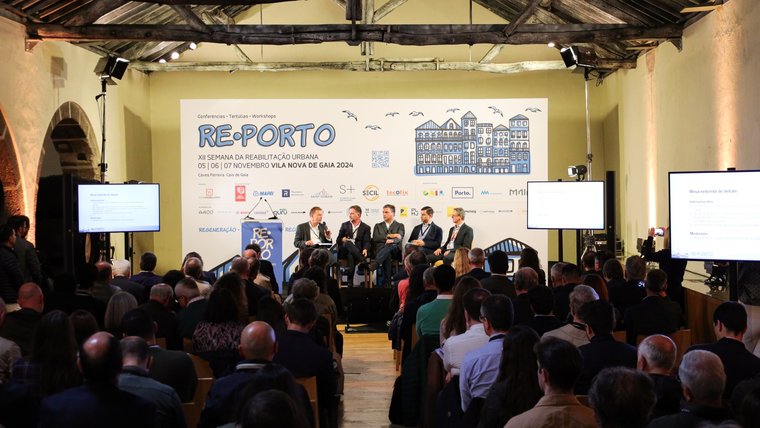
On the first day of the event, the mayors of Greater Porto (Maia, Matosinhos, Porto and Vila Nova de Gaia) met to discuss the challenges of housing in Portugal. The debate addressed the structural issues of housing and the demands for a coordinated and effective response in the different municipalities.
The round table on housing issues, moderated by António Gil Machado, director of Vida Imobiliária (organizer of the event) was attended by António Miguel Castro, chairman of the Board of Directors of Gaiurb, representing the mayor of Vila Nova de Gaia; António Silva Tiago, mayor of Maia; Carlos Mouta, deputy mayor of Matosinhos; and Ricardo Valente, city councillor of Porto.
António Miguel Castro stressed the importance of Portuguese cities providing an integrated response to various generations and social classes. “We need to invest more in relevance, in proposing added social value. We have cities with a lot of charisma, cities with many years and a lot of history, and we have a responsibility to provide these responses to all age groups,” he said.
In addition to housing, the mayors discussed the importance of infrastructure and mobility for the competitiveness of municipalities, with António Miguel Castro expressing the impact of infrastructure on regional growth, considering it essential for the future of cities. “These infrastructures, despite the weight they have now, are a necessary and temporary evil, which will qualify us indelibly. We are creating a very favorable ecosystem for our future”, he stressed.
The application of Simplex Urbanístico in licensing processes was another topic addressed at the SRU conferences, bringing together experts in a round table to reflect on the impact of the law on local authorities and the possibilities for improvement, with some representatives of the sector highlighting the need for adjustments to the law in order to optimize the efficiency of processes.
The round table featured a speech by the president of Gaiurb, for whom the biggest challenge of Simplex is to open up “a continuous path where we leave regulation and legislation to empower the territory and urban planning. Not to go backwards and forwards, because we don't have cities organized with detailed plans, we're always analysing”. António Miguel Castro also stressed that “we should be proud of the work we've done, regardless of the opportunities for improvement. The market is reacting, also with alternative solutions, with more industrialized construction.”
António Miguel Castro's vision focused on the importance of organizational culture and adapting to new realities. “An institution's organizational culture is fundamental. Our structure is very focused on innovation, on investing in technology, something that allows us to keep up with changes in the world and understand the need for continuous improvement,” he said, alluding to Gaiurb's work. For the company's president, Simplex has failed to change the paradigm, because instead of promoting planning, it has focused on inspection. “We've gone from appreciation to a focus on inspection, but we should be focusing on planning,” he lamented, pointing out that the introduction of tools like BIM can help anticipate future problems.
The president of Gaiurb highlighted the Gaia municipality's efforts to implement BIM and simplify licensing processes. “Simplex has added a challenge to the status quo in licensing processes, and whenever we change the status quo, we are changing the outlook for the future,” he said.
Although he recognizes that licensing processes are still complex, António Miguel Castro believes that the use of BIM will bring a valuable layer of information and improve the planning of buildings. “BIM will bring us a layer of information, a digitalization of the building that will order and plan the construction of buildings much better; it may put an end to some professions and give rise to others, but it's important for the municipality,” added the president of Gaiurb, stressing that adapting to this new reality also requires ‘continuous training of technicians’.
In the debate, the importance of robust technical knowledge and continuous training were highlighted as crucial for modular construction to be competitive and sustainable. “Knowledge is very important and we can't neglect it. Our value proposition at an individual level has to be compatible with that,” stressed António Miguel Castro, noting that by fostering an industrialized and modular approach, Portugal could become more competitive in the construction sector at European level in the future.
Of particular note was the parallel session organized by Gaiurb on the theme of "Digital Transition and BIM - Innovation in the Public Service", during which Marco Lima de Carvalho and Patrícia Baptista addressed the problem of innovation in public administration centred on digitization and procedural debureaucratization, as well as the path, projects and partnerships that are driving the implementation of BIM and the automation of urban planning verification.
For the second time at Caves Ferreira, in Cais de Gaia, the 12th edition of Porto's Urban Rehabilitation Week was attended by around 2,235 participants, responsible for 12,896 registrations in the event's various sessions, with the highest number of participants ever.
Translated with DeepL.com (free version)