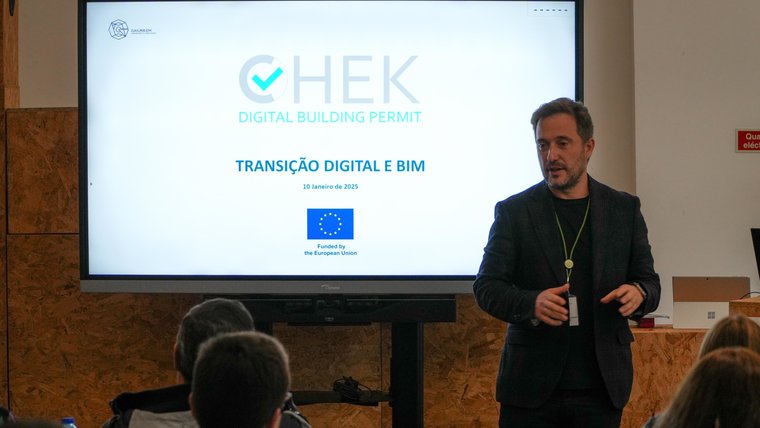
At the opening of the session, which promoted an active debate among the technicians, the Chairman of the Board of Directors of Gaiurb, António Miguel Castro, stressed the importance of CHEK for the company, for Portugal and for Europe, considering that the project “demonstrates Gaiurb's international recognition and its ability to innovate through the acquisition of knowledge and experimentation with cutting-edge solutions at world level”.
The session called for the active integration of the company's digital transition among technicians, highlighting the positive impact on the simplification and attractiveness of urban licensing, as well as improving citizen services. At the same time, the results of the digital transition that began in 2013 were presented, with emphasis on the creation of a digital twin of the city, which will allow automated verification of urban licensing rules based on IFC/BIM models. The initiative also aims to provide quality territorial information, contributing to the sustainable and efficient management of urban space.
With CHEK, Gaiurb is strengthening its position as an innovative company on the European scene, promoting digital solutions that directly benefit society and drive the modernization of the urban planning sector.
The CHEK - Change toolkit for digital building permits project has a duration of three years and is funded by the EU's Horizon Europe program (G.A. No. 101058559), contributing to greater speed (50%), greater appreciation of human work, more precision and objectivity, transparency and scalability, fair tax rates, new analysis methods for new challenges, lower CO2 emissions and reduced consumption of paper and resources are some of the project's advantages.
CHEK's main objective is to digitize the procedures for the prior control of building construction, replacing analogue systems with digital processes based on BIM (Building Information Modelling) models, digital twins and three-dimensional geographic information systems (3DCityGML). Gaiurb's technical team presented BIM concepts and methodologies, the evolution of its integration into the company's activity and specific advances within the scope of the CHEK project.
The session provided an approach to the applications of BIM in construction and urban planning, as a methodology for sharing information and collaboration between all those involved and during all phases of a building's life cycle, which is based on a digital model, accessible by software and which allows the virtual manipulation of that same building.
In practical terms, BIM allows all parties involved in a project (architects, engineers, builders, clients, etc.) to share information and work collaboratively, resulting in a more efficient construction process, with fewer errors and wasted resources. There are several benefits to this information-sharing methodology: efficiency and cost reduction, with improvements in planning and resource management, as well as identifying problems before execution; improved collaboration; simulation and analysis (it is possible to simulate the behavior of a building, helping to make more informed decisions); lifecycle management (managing the operation and maintenance of a building throughout its useful life); visualization (the use of the 3D model allows for better visualization of the project, facilitating the understanding of all parties involved, as well as identifying and correcting errors in planning before they are implemented).
Within the scope of Gaiurb's activity, BIM has already come a long way, with very positive results that should be remembered:
2012 | Start of NoPaper digital processes;
2013 | Launch of the first three NOPaper products;
2016 | Recognition of NOPaper as a Smart City project;
2017 | Use of laser technology in public projects;
2018 | Presentation of the GAIA BIM project, reception of BIM files (IFC);
2019/2020 | Start of research work in partnership with CYPE/ CHEK application.
Translated with DeepL.com (free version)